
REVIEW · TUK-TUKS
Valencia: Tuk tuk tour
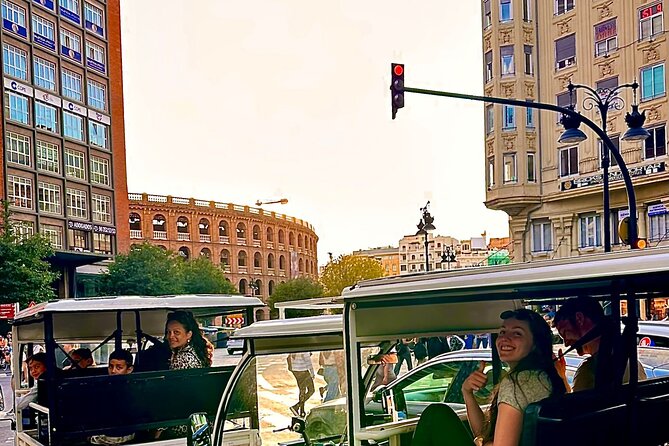
Tuk-tuks make Valencia snap into focus. This short, guided ride strings together medieval gates, Turia-area landmarks, beaches, and the big modern statements of the city, all in about 1 to 2 hours. I love the open-air format for getting quick views as you move, and I also like the route-efficient stops, so you are not spending your day figuring out routes. The tradeoff is simple: traffic noise can make it harder to catch every detail, and anything you would normally look up at may be partly blocked.
You will also feel the planning in the small group size, with a maximum of 12 people. Guides come in English (and several other languages), plus you get 1 bottle of water per person.
Key points
- A 1 to 2 hour orientation that hits top sights without a long walking day
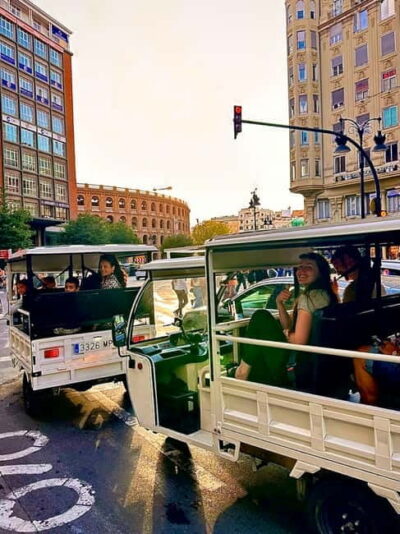
- Open-air tuk-tuk riding that is fun, quick, and easier in heat
- Multiple Valencia eras from Gothic city walls to modernist architecture
- Frequent photo moments at vantage points like the Serrano Towers
- Small groups up to 12 which helps the experience feel less rushed
- $32.44 with water included, plus a guide in English
Price and Value: What You Really Get for $32.44
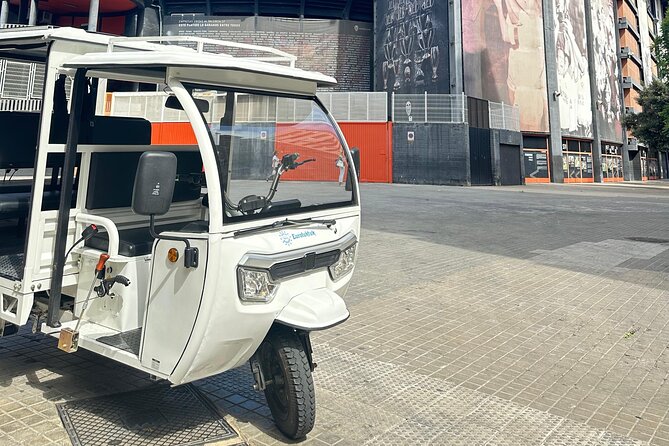
At $32.44 per person for a group tour that runs about 1 to 2 hours, the value here is not in a museum ticket. It is in the time you save. You are getting guided stops across neighborhoods that normally take you multiple buses, taxis, and walking to stitch together.
There is also real convenience baked in. You get 1 bottle of water included, and you are on a small-vehicle ride that can reach areas where regular traffic may be more annoying. Add in that the tour is designed for short sightseeing, not deep study, and it makes sense as a first-day or half-day plan.
One practical note: you might see slight differences in actual timing depending on how the day goes. That is not unusual in a city where traffic and street conditions shift. So if you are trying to squeeze the tour right before dinner, give yourself a cushion.
Getting Oriented: Meeting Point, Group Size, and the Tuk-Tuk Feel
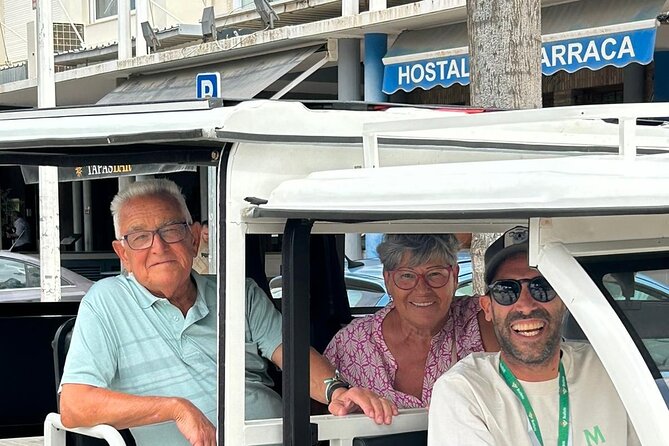
You meet at C. de la Blanqueria, 3, Ciutat Vella, 46003 Valencia, and the tour returns you back to that same meeting point. Ciutat Vella is handy because you can later walk into smaller streets and explore on your own.
The group limit is 12 travelers, and the experience is offered in English. The operator also runs guides in Spanish, Portuguese, Italian, and German, which is useful if your group includes mixed language comfort.
Inside the tuk-tuk, expect an open, street-level view. One downside can be visibility for tall buildings or anything you would normally look upward toward. Another downside can be sound. If you are unlucky with traffic volume, it can be harder to hear the guide clearly. If you care a lot about audio, aim for a slot when streets are less chaotic, like earlier in the day.
The rest of Valencia, one booking at a time
- Valencia: Oceanogràfic Entry Ticket
★ 4.7 · 9,893 reviews - Valencia: 24 or 48-Hour Hop-on Hop-off Bus Ticket
★ 3.9 · 5,611 reviews - Valencia: Palosanto Flamenco Show Ticket
★ 4.8 · 3,876 reviews - Valencia: Catamaran Cruise with Sunset Option
★ 4.0 · 3,566 reviews
Serrano Towers to Sea Gate: Medieval Valencia Up Close (and Up Optional)
This tour gives you a strong early hit of Valencia’s defensive past at the Serrano Towers. These two polygonal towers flanking a central arch were built between 1392 and 1398, under architect Pere Balaguer, as part of the medieval city wall. Their job was defense, and over centuries they also served as a prison for nobles before becoming a historic monument.
The practical win is this: the tuk-tuk ride gets you to the right place quickly, then the towers offer the chance to do more than just look from the street. You can explore the interior and climb for one of the best views of the city. Even if you do not climb, the architecture reads well, and it is an easy moment to take photos that feel distinct from the beach-and-building shots.
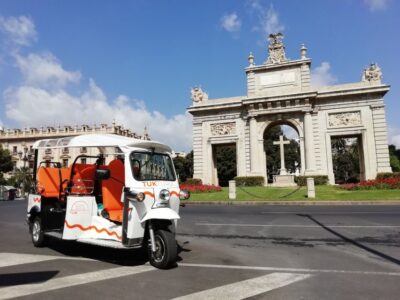
Then you shift to the Sea Gate, which sounds ancient but is actually a modern reconstruction. It was rebuilt in 1946 to honor those who died in the Spanish Civil War. It is white stone with three arches, with the center arch being the largest. If you like symbolism, this is a good stop because it shows how cities rebuild memory into stone.
Turia Gardens and the Flower-Changing Bridge You Might Catch (If Timing Helps)
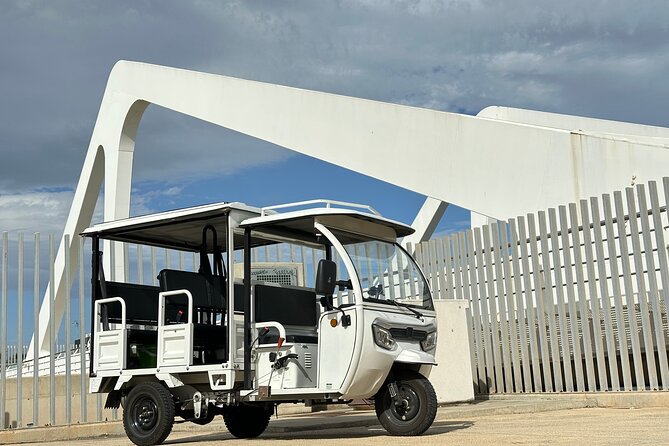
Next comes a bridge that ties into Valencia’s seasonal rhythm. This bridge opened in 2002 and was built as an extra crossing over the Turia Gardens. A fun detail is the flower schedule: every four months the flowers change. That is why people call it the most expensive bridge in Valencia.
Here is the timing consideration. If your visit lands in the month when flowers are in transition, the bridge may not look like your online photos. The info you are given notes that September is when the flowers change again, and that you should expect the “best look” outside those shift windows.
Even so, this is still a worthwhile stop in a tuk-tuk tour because it visually connects two big ideas: the planned city green space of the Turia and the city’s love of public, Instagram-able details.
Mestalla Stadium: Football Energy Without Waiting for a Ticket
The tour rolls past Mestalla, home of Valencia CF. The stadium opened in 1923, seating about 50,000, and it is known for its steep stands that bring fans closer to the pitch.
Why this works in a short tour: you get a sense of Valencia as a modern, sports-driven city without needing a full stadium day. It is also a nice break from purely architectural stops. If you are a football fan, this kind of exterior and neighborhood context helps you understand why certain areas feel lively even on non-game days.
If you are not a football fan, it still adds texture. It is a reminder that big cities are not only buildings and museums. They are also rituals and crowds, and Mestalla is one of Valencia’s most iconic ones.
Old Port and Veles e Vents: Where the City Turns Maritime
The route continues to the old port of Valencia, which covers about one million square meters. The focus here is not just boats. It is described as a center for culture, innovation, business, and activities. In other words, the port is not frozen in time.
You also get the Veles e Vents area, known for its unique architecture. That venue hosts exhibitions, dance events, and different arts programming, so it is not only functional waterfront space. It is part of Valencia’s creative engine.
Then the tour references the tinglados and old shipyard, with many private moorings for boats and service companies. Sports clubs and federations are included too, with sailing, diving, and kayaking mentioned. If you like cities that still have working waterfront energy, this stop delivers.
The practical value: this is a good place for photos where the skyline feels different. It is also a logical bridge between the city center vibe and the beach.
Beaches: Malvarrosa for Easy Access, Las Arenas for Local Name Flavor
Valencia’s beaches work well on a quick circuit because you get the change of mood fast. The tour includes two: Malvarrosa and Las Arenas.
Malvarrosa is called Valencia’s most famous beach and it has inspired artists. In the mid-19th century, it shifted from being a flower area to becoming the beach you recognize today. Expect wide, fine golden sand and easy access to the city. That makes it a good choice even if you do not plan to swim. You get the “Valencia by the sea” feeling without needing a separate transit plan.
Then you reach Las Arenas, named after the old fishing quarter. Locals still call it Las Arenas, tied to an old spa that has since become a luxury hotel complex. This is the more local-sounding stop. It also has many restaurants and entertainment options. Some spots can turn into nightlife areas, and the route specifically mentions the Marina Beach Club.
If you are deciding between beach stops elsewhere in Valencia, this pairing is a strength. Malvarrosa gives you the obvious postcard view. Las Arenas gives you a slightly different social feel, with more food-and-fun energy near the sand.
City of Arts and Sciences, Central Market, and the Big Modern Valencia Moments

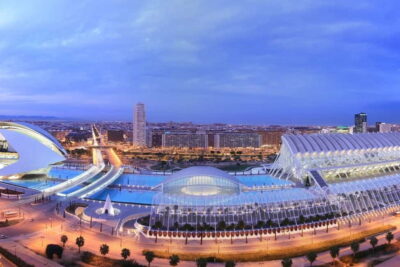
Then comes the part of Valencia that many people plan their trip around: the City of Arts and Sciences. The complex is designed by Santiago Calatrava and Félix Candela, with construction beginning in 1996 and ending in 2009. The stated goal was to revitalize Valencia and position it as a cultural, scientific, and leisure hub with international appeal.
In a tuk-tuk tour, you do not need hours here to feel the impact. The buildings are instantly recognizable, and even a short stop gives you a strong “wow, this is modern Valencia” moment. If you care about architecture, you will appreciate how the complex changes the entire feel of the area compared to the older city gates you saw earlier.
The route also includes a major modern shopping and dining structure, a market-style building opened in 1928 and designed by Francisco Mora. It was part of a modernization project for commerce in the city center. You are told it features colorful mosaics, ornate columns, and a large glass dome. It was renovated in 2003 to become a place for restaurants, cafes, and gourmet food, described as a symbol of Valencia’s architectural heritage and modernity. That is a big shift from “look at buildings” to “plan where you can eat,” which is exactly what you want from a highlights tour.
Finally, you get the Central Market of Valencia, also opened in 1928. It is one of Spain’s oldest and most active markets, with modernist architecture. The iron-and-glass dome and colorful ceramics make it instantly photogenic, and it is positioned close to other key landmarks like La Lonja and Plaza del Ayuntamiento.
If you want one practical move after this tour, do it like this: plan to use your market visit as your meal anchor. Central Market is the kind of place where your schedule can turn from sightseeing into eating fast, in a good way.
Bullring, Estación del Norte, and Quart Towers: Architecture That Changes the Mood
A tuk-tuk tour in Valencia should not only show bright futuristic icons. It should also show how the city mixes styles, and this route does that.
First, there is the Bullring, opened in 1859 and described as one of Spain’s emblematic venues, with neoclassical architecture. It seats about 10,000 and has a circular brick structure with Doric columns, inspired by the Roman Colosseum. Today it hosts cultural events and concerts, not only bullfighting, which makes it easier to appreciate even if you are not into the sport.
Then you visit Estación del Norte, opened in 1917. It is a modernist icon by architect Demetrio Ribes, built to modernize and expand Valencia’s railway infrastructure. The station is filled with colorful ceramics and Valencian-style tiles, with ornamental details that reflect local cultural richness. One of the descriptions you get is that the lobby feels elegant and reminiscent of a popular fantasy-film look, with an inviting waiting area.
If you are the kind of traveler who loves stepping into dramatic public interiors, this is a strong stop. Even if you are not taking the train, you get that “this city takes design seriously” feeling.
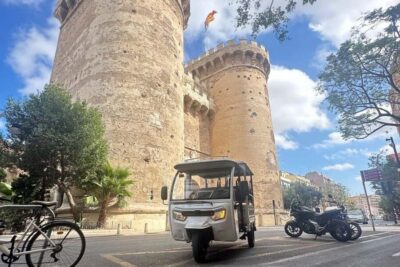
To end on a defensive note, the tour includes the Quart Towers, built between 1441 and 1460. These are medieval city gates connected to the defensive wall, located on the road to Quart, which linked Valencia with the west and north. They are robust, with two cylindrical towers joined by a wall and a large arch, made of brick with Gothic elements. They were damaged during the War of Independence and restored in the 19th century.
This finish is smart because it returns you to the medieval theme you started with. It helps the whole route feel like a story instead of a random set of stops.
Guides and Real-World Timing: How to Get the Best Experience
Names you might hear in this experience include Tony, Salvador, Silvio, Sebastian, Francisco, and Christian, with praise for friendly, personable driving and clear answers to questions. If you want a smoother ride, show up a few minutes early and be ready at the meeting spot. One reason people get frustrated with short tours is simply not finding the exact pickup point fast enough.
Timing also matters. Valencia traffic can slow things down, and the tuk-tuk soundscape can make it harder to catch every line from the guide when streets are loud. If you want the best hearing conditions, consider scheduling for earlier or later daylight rather than the middle of the hottest period.
Also plan your expectations. This is not a “stand and study everything” tour. It is a highlights circuit. You will leave with a lot of pointers for what to return to later, especially if you want to climb the towers, spend more time at markets, or linger at the City of Arts and Sciences.
Should You Book This Tuk-Tuk Highlights Tour?
Book it if you want a fast, guided overview across Valencia’s biggest contrasts: Gothic towers, modern architecture, markets, beaches, and a waterfront that still feels active. It is also a good pick if you do not want to spend your holiday negotiating buses and long walks, or if you just want a fun, easy way to see a lot in 1 to 2 hours.
Skip it if you need long stop times at one place, or if you are extremely sensitive to hearing the guide in traffic noise. Also think twice if you are looking for a lot of top-down views, because parts of the tuk-tuk design can make looking upward harder.
If you are trying to build a first-day plan, this is a solid anchor. Use it to get your bearings fast, then come back on your own to the few spots you care about most.
FAQ
How long is the Valencia tuk-tuk tour?
The duration is listed as about 1 to 2 hours.
How much does the tour cost?
It costs $32.44 per person.
Is the tour offered in English?
Yes, the guide is offered in English.
What is included in the price?
The tour includes 1 bottle of water per person and guided commentary.
Do I need to tip?
Tips are not included.
Where do I meet for the tour?
The meeting point is C. de la Blanqueria, 3, Ciutat Vella, 46003 Valencia, Spain.
Where does the tour end?
It ends back at the same meeting point.
What is the maximum group size?
The tour has a maximum of 12 travelers.
Are service animals allowed?
Yes, service animals are allowed.
Can I cancel for a full refund?
Yes. You can cancel up to 24 hours in advance for a full refund. If you cancel within 24 hours, the amount you paid is not refunded.
More Tours in Valencia




More Tour Reviews in Valencia





More Valencia, Booked and Rated
Newest Valencia write-ups


Tuk-Tuks, side by side.
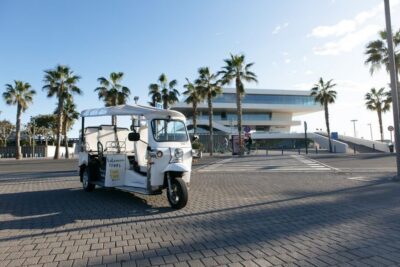 ★ 4.8Complete Tuk-Tuk Tour Around the CityFrom $47793 reviews
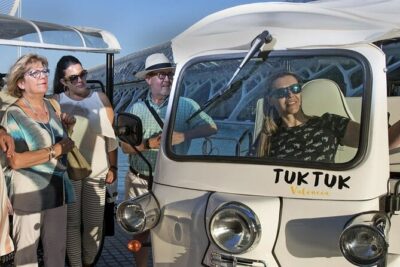 ★ 4.5Valencia Complete Tour by Tuk TukFrom $48593 reviews
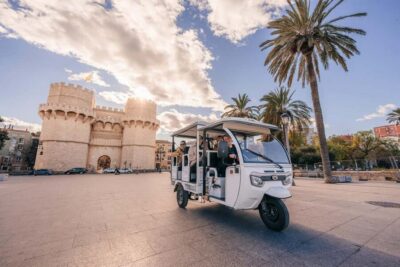 ★ 4.72-hour City Highlights Guided Tuk-Tuk TourFrom $46233 reviews
 ★ 4.7Full Tuk Tuk Tour 2HFrom $40233 reviews
 ★ 4.6Alicante Tuk Tuk Overview TourFrom $117131 reviews
 ★ 4.8Tuk Tuk City TourFrom $4472 reviews
 ★ 4.5Tuk Tuk Full City TourFrom $4756 reviews
 ★ 4.8Historical Tour by Tuk Tuk 1HFrom $2728 reviews
Filed in